
4×1000W-Class Mobile Lighting Tower: Structural Breakdown and Routine Maintenance Points
From luminaire layout to reliability management—a practical breakdown for procurement and engineering personnel
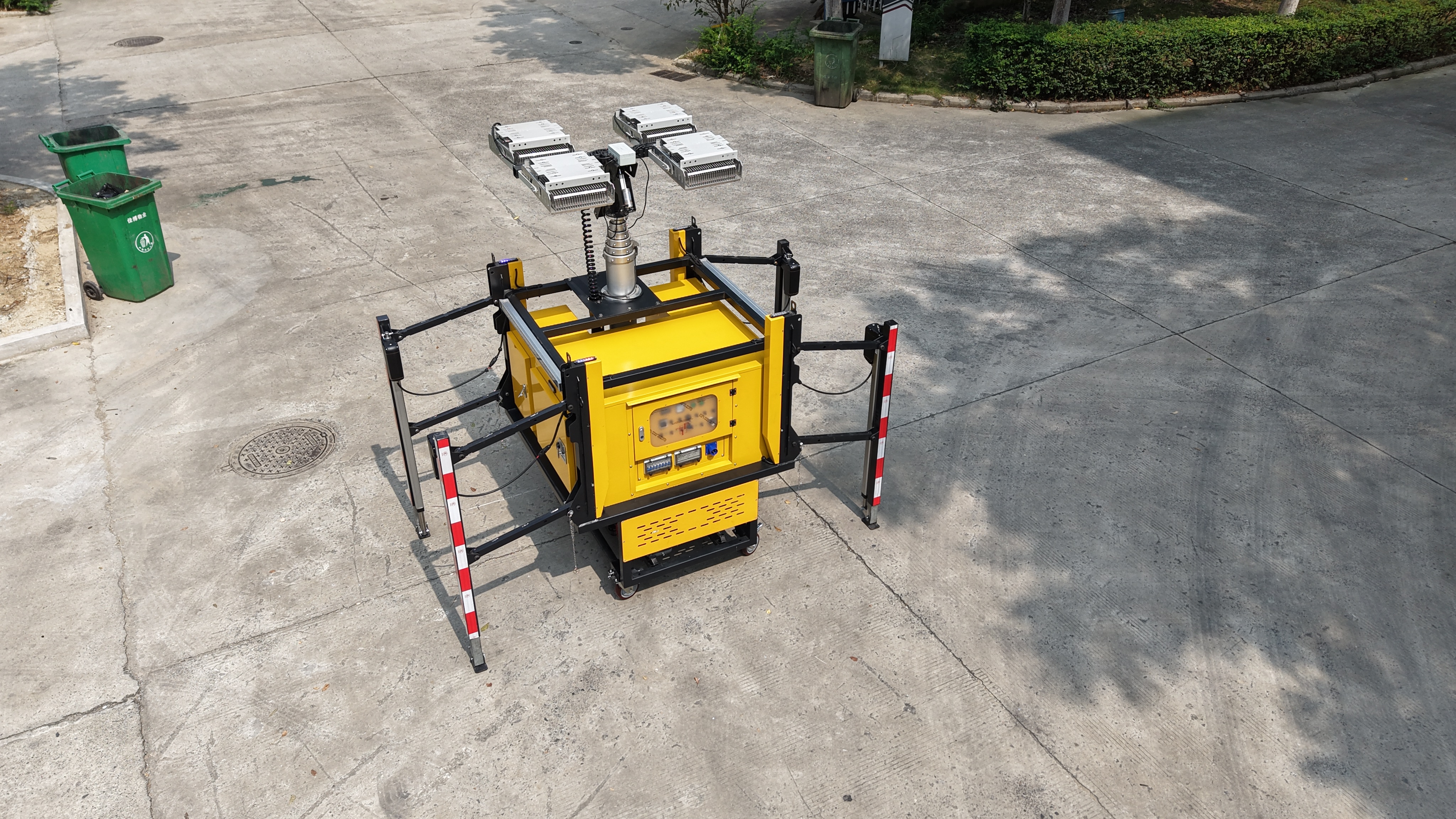
Lamp Arrays and Lifting Structures: Engineering Logic of 4×1000W Layout
The core feature of 4×1000W mobile lighting towers lies in the combination of lamp quantity and individual lamp power. The four lamp units are not simply stacked but arranged symmetrically or in zones around the lifting mast, giving the light pattern an adjustable coverage profile on the horizontal plane. When evaluating, procurement personnel should pay attention to the adjustment freedom of the lamp brackets—whether they can independently tilt and rotate horizontally determines whether obstructions can be avoided and ineffective projection reduced during on-site lighting setup.
Regarding lifting structures, such towers typically use pneumatic or hydraulic methods to raise the lamp arrays to working height. The key to structural design is not the lifting height itself but the locking method and wind resistance stability after lifting. Engineering personnel should note the fit clearance between mast sections, the insertion depth of locking pins, and the deployment width of the base support surface. These details directly affect the tower's standing reliability on soft ground or slopes in the field. Contact the supplier for detailed structural parameters.
Electrical Circuits and Power Supply Coordination: Easily Overlooked Reliability Aspects
Four 1000W lamp units operating simultaneously impose requirements on grouped management of power supply circuits. A reasonable approach is to divide the lamp arrays into several independent branches, allowing partial lamp activation according to on-site needs, which both reduces generator load pressure and minimizes unnecessary energy consumption. During procurement, confirm whether the distribution box has branch control and independent protection rather than all lamps sharing a single switch.
Regarding power supply coordination, mobile lighting towers are typically used in conjunction with generator equipment. Engineering personnel should pay attention to the cable connection method on the tower side, the protection rating of connectors, and the cable storage structure. Common on-site failures are not lamp damage itself but moisture in connectors, cables being crushed, or improper storage causing insulation damage. Therefore, the design rationality of cable reels or storage compartments should be included in procurement evaluation.
Daily Inspection: Embedding Maintenance Actions into Workflow
The reliability of mobile lighting towers largely depends on the quality of daily inspections. It is recommended to divide inspections into two checkpoints: pre-shift and post-shift. Pre-shift checks should focus on lamp lens cleanliness, locking status of lamp bracket, smooth mast lifting, and cable appearance for damage; post-shift checks should focus on normal lamp body temperature, proper stowage, and whether the chassis has leakage or foreign object entanglement.
- Lamp Lens and Heat Dissipation: Dust accumulation on the lamp lens reduces light output efficiency and affects heat dissipation. Clean with a soft cloth and avoid corrosive solvents.
- Lifting Mechanism: Regularly check the joint sealing of pneumatic or hydraulic lines and observe for jamming or abnormal noise during lifting.
- Electrical Connectors: Check plugs and sockets for oxidation or looseness. Dry treatment should be performed after use in rainy seasons or high-humidity environments.
- Chassis and Supports: Check tire pressure and thread lubrication of support legs to ensure even load distribution on the support surface during parking.
Fault Prevention and Life Management: From Reactive Repair to Proactive Management
Common faults of this equipment are concentrated in three areas: lamp group failure to light or flickering, incomplete lifting, and power supply circuit tripping. Troubleshooting should start from the power input, confirming connectors, branch switches, and ballast or driver components level by level, avoiding direct disassembly of the lamp group. For lifting abnormalities, rule out line leakage and mechanical jamming first, then assess the power unit status.
For life management, it is recommended to establish a per-unit maintenance record, documenting problems found in each inspection and the handling methods, forming a traceable maintenance file. Lamps are consumable components, and their actual service life is related to usage frequency, heat dissipation conditions, and voltage stability; replacement cycles should not be determined simply by years of service. Procurement personnel may request a list of wear parts and replacement guidelines from suppliers during inquiry to facilitate subsequent self-maintenance. It should be noted that specific maintenance cycles and component life vary significantly with operating conditions; determination should be based on actual operating conditions and supplier technical documentation.