
Self-Loading Power Generation Shelter and Drainage Robot: Equipment Synergy Approach for Emergency Drainage Scenarios
A Practical Combination Logic for Drainage Equipment from Entry, Power Supply to Lighting
I. Why Emergency Drainage Requires Equipment Synergy Rather Than Single-Point Procurement
Site conditions for emergency drainage tasks are often unfavorable: narrow roads, unknown water depth, limited visibility during night operations, and power outages. Even if a single piece of equipment meets performance requirements, it may fail to achieve sustained operational capability due to difficulties in entry, power mismatch, or insufficient lighting. Therefore, procurement and engineering personnel should focus more on the interface relationships between equipment rather than isolated comparison of specifications of a single machine.
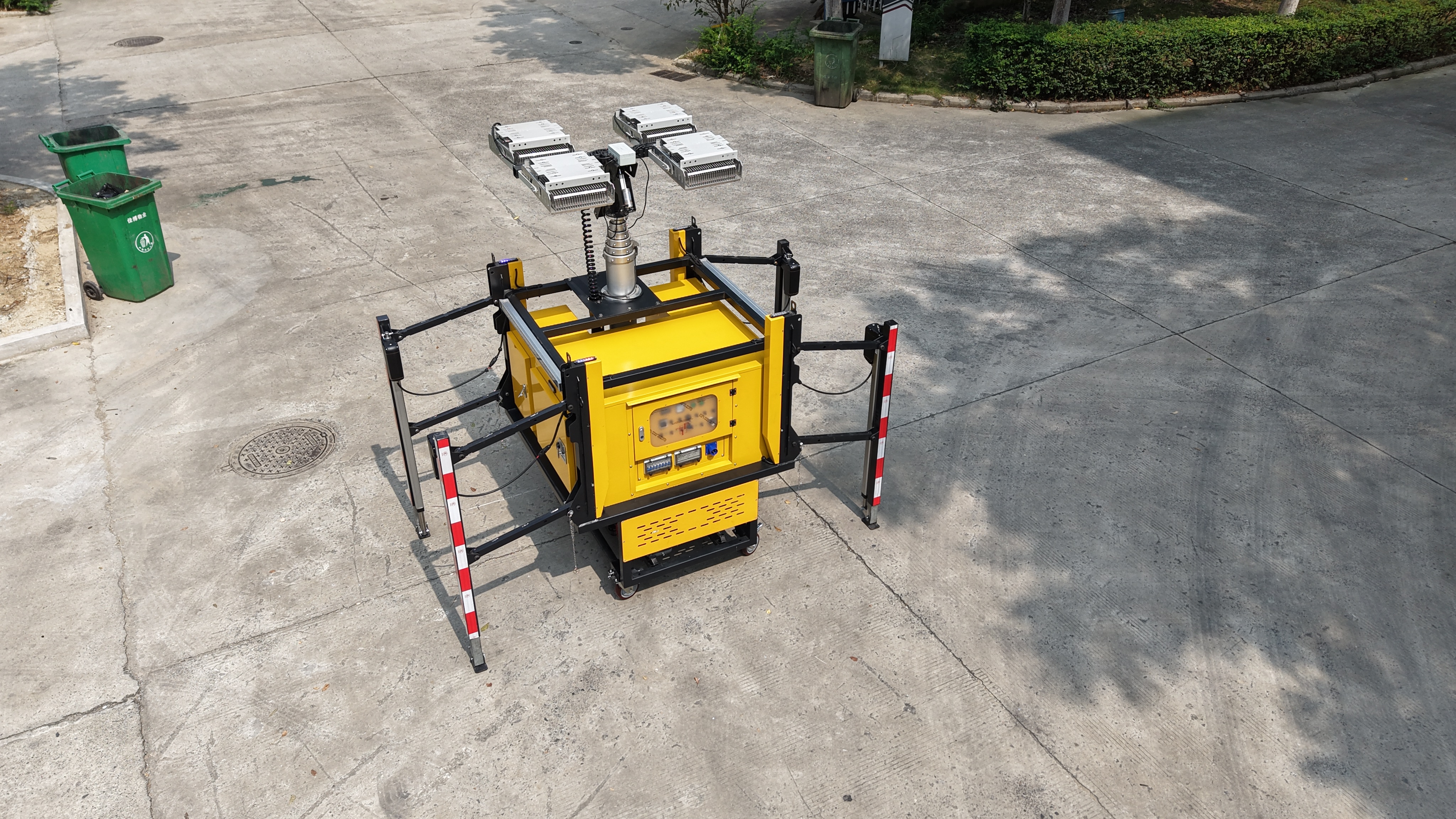
Taking the emergency lighting and power generation equipment direction focused on by Anhui Rongpan Technology Co., Ltd. as an example, a typical combination is: self-loading power generation shelter responsible for power supply upon arrival, drainage robot undertaking pumping operations in underwater or low-lying areas, and site lighting providing continuous illumination for the work area. The three have clear division of labor and are mutually conditional.
II. Self-Loading Power Generation Shelter: Solving the Problem of 'Power Supply Upon Arrival'
In emergency scenarios, the value of power generation equipment lies not only in power output but also in how quickly it can be put into operation upon arrival at the site. The design concept of the self-loading and self-unloading power generation shelter is to enable the shelter to load and unload itself, reducing dependence on auxiliary equipment such as cranes and forklifts, so that deployment can still be completed when road conditions are restricted and loading and unloading resources are tight.
From a selection perspective, it is recommended to focus on the following points:
- Loading and unloading method and site adaptability: Understand the requirements of the shelter's loading and unloading mechanism for ground flatness and load-bearing capacity, and confirm whether the site has the conditions for deployment.
- Power supply interfaces and scalability: Check whether the shelter is equipped with multiple output interfaces and whether it can simultaneously supply power to drainage equipment, lighting fixtures, and other emergency loads.
- Adaptability to operating environment: Pay attention to design orientations such as rain protection, heat dissipation, and noise reduction. For specific protection ratings and noise indicators, please contact the manufacturer for detailed parameters.
- Transportation and storage: Check whether the shelter's dimensions match the transport vehicles and whether additional protection is required for long-term storage.
It should be noted that the load composition varies considerably across projects. The capacity configuration of the power generation shelter should be comprehensively determined based on the actual power of drainage equipment, lighting load, and backup margin, and should not be simply applied according to empirical values.
III. Drainage robots: delivering pumping and drainage capability to locations that are difficult for people to reach
Drainage robots are typically designed for low-lying areas, underground spaces, narrow pipes and culverts, and other scenarios. Their advantage lies in replacing personnel to enter flooded areas for operations and reducing safety risks. During procurement, starting from task matching, attention should be paid to the robot's passability, pumping and drainage method, power source, and coordination with the control terminal.
When coordinating with the power generation shelter, two points need to be confirmed: first, whether the robot's power supply or charging method matches the shelter's output; second, whether the robot's operating radius and the shelter's placement position are coordinated, so as to avoid limiting the operating range due to cable length or power supply distance. For occasions requiring long-term continuous drainage, equipment rotation and heat dissipation intervals should also be considered. For specific endurance and flow parameters, it is recommended to consult the manufacturer.
IV. Site lighting fixtures: the operational foundation for nighttime drainage
Drainage operations often continue into the night, and insufficient lighting directly affects operational efficiency and on-site safety. The role of site lighting is not merely to "illuminate" but to provide uniform, adjustable lighting coverage for equipment operation areas, personnel passage areas, and drainage outlet observation areas.
When selecting models, consider the lighting layout (mobile, lifting, etc.), beam angle adjustment capability, voltage compatibility with the generator cabin, and the lamp housing's protection design for humid environments. If multiple lights need to work in coordination on site, confirm whether the cabin's output circuits can meet simultaneous power supply requirements. Please contact us for detailed parameters such as luminous flux and illumination distance.
V. Coordinated Layout Recommendations for Procurement and Engineering Personnel
- Define the task before the equipment: Clarify the drainage area, water depth, operation duration, and site access conditions, then work backward to determine cabin capacity, robot type, and lighting quantity.
- Reserve interface capacity: The cabin's output interfaces should have some expansion space to facilitate temporary addition of lighting or other emergency loads.
- Pay attention to arrival sequence: The arrival order of self-loading cabins and drainage robots affects deployment efficiency. Plan the unloading position and work face connection in advance.
- Verify environmental adaptability: Humid, muddy, and low-temperature conditions significantly affect equipment. Confirm relevant protection and adaptability information with the manufacturer item by item.
The selection of emergency drainage equipment is essentially about organizing power supply, pumping, and lighting into an operational work chain. Anhui Rongpan Technology Co., Ltd. continues to invest in emergency lighting and power generation equipment. Product parameters and configuration plans can be further obtained through official channels.