
Self-Loading Mobile Lighting Tower: Key Equipment for Rapid Lighting Deployment at Emergency Sites
From Loading Methods to Selection Criteria: What Procurement and Engineering Personnel Need to Know
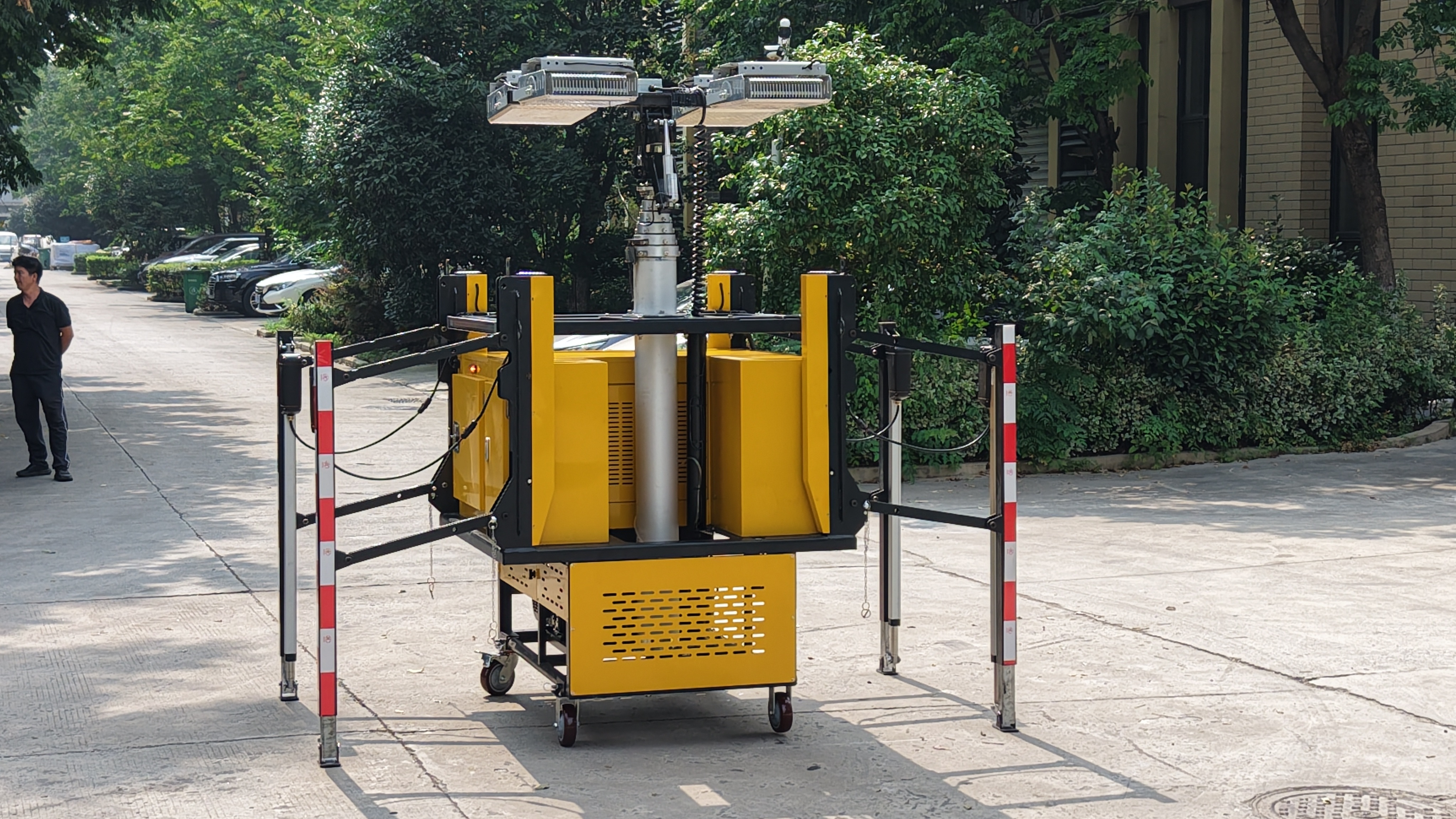
I. What Is a Self-Loading Mobile Lighting Tower
A self-loading mobile lighting tower is a type of mobile lighting equipment that integrates lighting fixtures, an elevating light mast, a generator set, and a transport chassis into a single unit, with self-loading and unloading capability. Unlike traditional lighting equipment that requires a crane or forklift for loading, this type of equipment is typically equipped with hydraulic outriggers, tilting mechanisms, or dedicated loading arms, enabling loading, unloading, and on-site positioning without lifting equipment.
Its typical structure includes: chassis and traveling system, loading mechanism, power generation and distribution unit, elevating light mast, and lighting fixtures and dimming control module. Anhui Rongpan Technology Co., Ltd. continues to invest in emergency lighting and power generation equipment, designing products around the actual needs of scenarios such as power, municipal, firefighting, mining, and agriculture, with emphasis on deployment efficiency and on-site adaptability.
Key Structural Considerations
- Chassis and Outriggers: Determine equipment stability on uneven terrain; outrigger deployment range and ground adaptability are key evaluation points.
- Telescopic Mast: Affects lighting coverage height and range; must be matched to site space and illuminance requirements.
- Power Generation and Distribution: Provides independent power to the light array, involving output stability and load distribution.
- Loading and Unloading Mechanism: The core of self-loading capability, directly determining feasibility for single-person or minimal-crew operation.
II. Self-Loading Methods and Deployment Process
The loading and unloading logic of self-loading mobile lighting towers essentially converts external lifting requirements into the equipment's own mechanical actions. Common implementation approaches include hydraulic outrigger jacking combined with chassis lifting, flip-type loading arms, and hybrid methods combining towing and self-propulsion. Different approaches impose varying requirements on site conditions, operator count, and preparation time.
Taking a typical deployment process as an example: after the transport vehicle is in position, the equipment detaches from the cargo bed via its own loading mechanism and lands on the ground; operators deploy outriggers and level the unit; the power generation unit is started and the mast raised to working height; light array orientation and beam angle are adjusted according to site requirements. Retraction follows the reverse sequence. Throughout the process, reduced dependence on external lifting resources is a primary reason such equipment attracts attention in emergency scenarios.
Factors Affecting Deployment Efficiency
- Site levelness and load-bearing capacity, affecting outrigger deployment and leveling time.
- Operator proficiency, involving coordination between the loading mechanism and lifting system.
- Starting method and warm-up preparation of the power generation unit.
- Number of light fixtures and wiring complexity.
III. Application Scenarios and Configuration Approach
Self-loading mobile lighting towers are typically used in scenarios sharing common characteristics of tight timelines, unfamiliar sites, and uncertain power supply. Power emergency repair sites require nighttime work lighting; municipal road and pipeline construction requires temporary lighting; firefighting and emergency rescue require establishing lighting coverage in areas without fixed power; mining and agricultural operations use them in remote or open sites. Different scenarios impose varying requirements on illuminance range, runtime, wind resistance, and transport methods.
In terms of configuration, procurement personnel may first clarify three questions: the area and height requirements for lighting coverage, the duration of a single continuous operation, and the frequency of transportation and relocation. On this basis, they can then discuss with suppliers the types of light sets, power generation ranges, light pole forms, and chassis structures. When specific technical parameters are involved, it is advisable to request detailed information from manufacturers and verify it against on-site conditions, avoiding judgments based on a single indicator alone.
IV. Key Points for Model Selection and Acceptance
For procurement and engineering personnel, the following dimensions may be considered during the selection stage:
- Loading and unloading safety: Whether the loading and unloading mechanism has anti-overturning and misoperation protection designs, and whether the operating instructions are clear.
- Structural strength: The stability of the light pole in the raised state, and the reliability of the connection between the outriggers and the chassis.
- Electrical safety: Grounding, leakage protection, and line protection of the power distribution unit.
- Environmental adaptability: The dust and water resistance rating and operating temperature range should be confirmed according to the region of use.
- Maintenance convenience: Whether vulnerable parts replacement and routine inspection points are easily accessible.
During the acceptance stage, it is recommended to conduct actual loading and unloading as well as raising and lowering drills, record the preparation time and operating steps, and verify the consistency of the accompanying documents with the manual. For organizations that require frequent relocation, the transport fixation method and road adaptability should also be evaluated.
V. Operation and Maintenance Management and Usage Recommendations
The self-loading mobile lighting tower is an integrated mechanical-electrical-hydraulic equipment. Daily management should establish records to track loading and unloading times, operating hours, and maintenance conditions. The hydraulic system requires regular checks of oil levels and sealing conditions; the power generation unit should be maintained according to the instructions; the light sets and lines should be kept clean and dry. For long-term storage, a flat site should be selected and dust and moisture prevention measures should be taken.
Operator training is equally important. Loading and unloading as well as raising and lowering involve coordinated mechanical actions, which should be performed by trained personnel and follow the sequence of leveling the outriggers first and then raising the pole. Anhui Rongpan Technology Co., Ltd. provides products and technical support in the fields of emergency lighting and power generation equipment. For specific configurations and parameters, please contact us for detailed information so that appropriate choices can be made based on actual project conditions.